23 November 2026
How to Choose a Coffee Grinder Built to Last
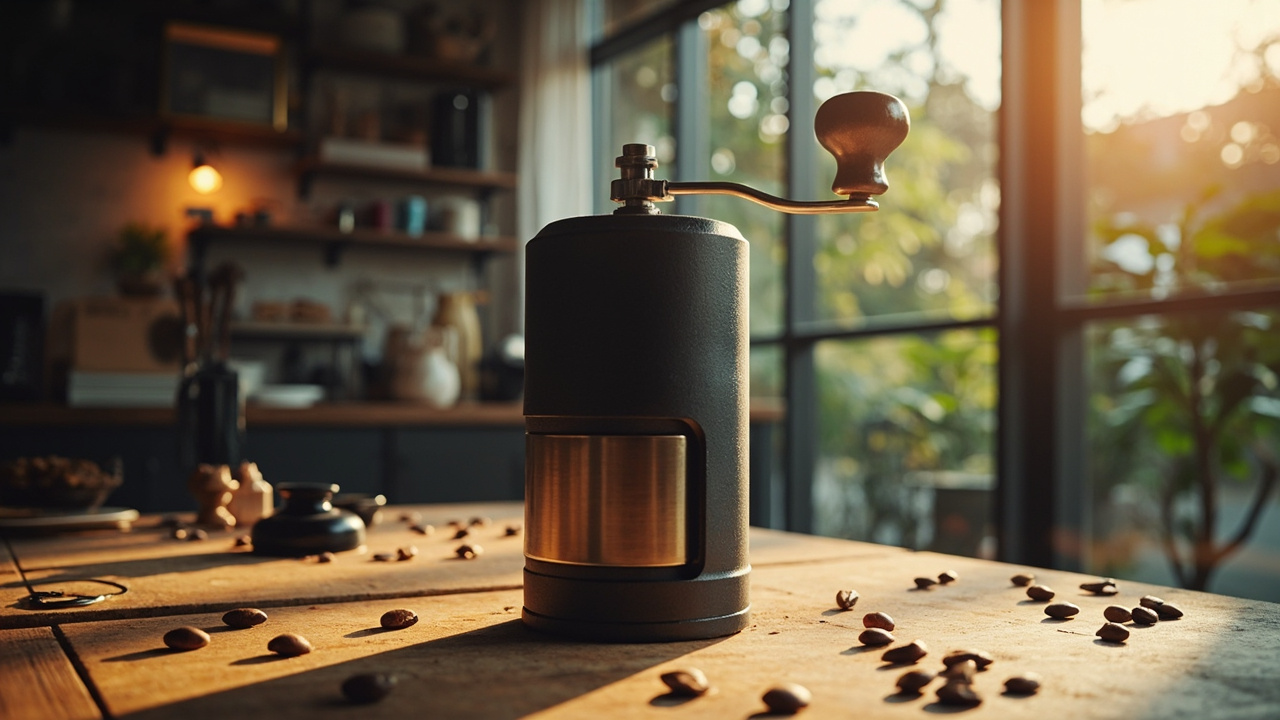
A grinder is often the most important—and most expensive—coffee tool in a home setup. The best long-term purchase is not simply the one with the longest specification sheet; it is the one you can adjust, clean, repair, and keep working when something eventually wears out.
Choosing a durable coffee grinder means evaluating serviceability, replacement parts, warranty coverage, and maintenance before comparing outputs. These factors usually matter more over several years than a small difference in performance at purchase time.
Table of contents
- Key takeaways
- What Makes a Coffee Grinder Durable?
- How Much Does Burr Quality Affect Lifespan?
- Which Parts Are Most Likely to Wear Out?
- How Important Are Spare Parts and Local Repairs?
- How Do You Set the Right Maintenance Budget?
- A Durable-Grinder Decision Checklist
- Sources
Key takeaways
- Choose a grinder with a documented service path: clear adjustment, accessible cleaning, available replacement parts, and a credible repair option.
- Burr quality affects consistency and durability, but alignment, housing design, cleaning access, and support determine how long the grinder remains practical.
- Burrs, gaskets, filters, and cleaning-related components are likely to wear out; a repairable coffee grinder should make them accessible.
- Spare-part availability, local repair capability, and clear warranty terms are more valuable than a headline specification.
- Budget for routine maintenance, likely consumables, and occasional repairs rather than treating a grinder as a disposable appliance.
What Makes a Coffee Grinder Durable?
A durable coffee grinder is built around maintainable components, repeatable adjustments, and access for routine cleaning. Its long-term usefulness depends less on producing excellent coffee on day one than on allowing an owner to keep it clean, aligned, and serviceable for years.
Durability is a system, not a single material. A metal housing can still fail because the adjustment mechanism is inaccessible, the motor is difficult to disassemble, or replacement parts are unavailable. Conversely, a well-designed grinder may use plastic in a non-critical area while keeping high-wear components easy to service.
What should you inspect before buying?
Start with the parts that receive the most attention and abuse:
- Burrs: Look for a defined burr type, clear access instructions, and a realistic adjustment range.
- Adjustment mechanism: It should hold its setting and allow incremental changes without a major reassembly.
- Cleaning access: Removable parts should be reachable without dismantling the entire machine.
- Fasteners and housing: Secure assemblies and robust casings make routine work less likely to damage the machine.
- Support: A meaningful warranty and accessible replacement parts indicate an expectation that the product will remain in use.
The design differences between conical and flat burr grinders matter, but neither type should be chosen by burr shape alone. Consider how the grinder will be cleaned, adjusted, and repaired after the first year.
A used machine can also reveal construction weaknesses that are not obvious in a new product. The buying-used coffee grinder guide helps assess wear, missing components, adjustment stability, and repair feasibility.
How Much Does Burr Quality Affect Lifespan?
Burr quality strongly influences particle consistency and cutting stress, but burr lifespan also depends on alignment, motor load, cleanliness, and the materials surrounding the burr set. A precision burr in a poorly maintained grinder can wear unevenly, while durable burrs in a neglected machine can still lose performance.
Burrs should cut coffee rather than crush it. This reduces the force required to pass beans through the mechanism, creates less heat, and generally gives the grinder a cleaner operating load. Even cutting also improves consistency when changing ratios or moving between filter and espresso-oriented recipes.
Is a harder burr automatically longer-lasting?
No. Hardness alone cannot determine service life. Burr geometry, chipping resistance, manufacturing consistency, and the way the burr set is supported all influence wear. A well-aligned set can last longer than a harder set that rubs unevenly or spins off-center.
Coffee grinder serviceability therefore extends beyond the burrs themselves. Before buying, ask practical questions:
- Can the burrs be removed without removing unrelated components?
- Is alignment described clearly enough for a technician to restore it?
- Are burr sets and adjustment parts offered as replaceable components?
- Does the design allow the motor to run briefly during cleaning, reducing the chance that coffee residue hardens into abrasive deposits?
- Are the directions understandable to an ordinary owner rather than limited to specialist knowledge?
Cleaning or realignment and full replacement are the two common burr interventions. Understanding the difference between replacing and realigning coffee burrs helps distinguish routine service from the need for a new set.
Which Parts Are Most Likely to Wear Out?
Burrs, gaskets, filters, and certain drive components are most likely to need attention during a grinder’s life. Their wear rates vary with use, but they should be treated as maintainable parts rather than automatic reasons to replace the entire machine.
Burrs and burr-set components
Burr edges lose sharpness as they cut thousands of coffee beans. Fine particles can also stick around the burr housing and beneath the outer burr. A grinder that traps most of its grounds in hard-to-reach cavities requires more frequent cleaning and may run hotter.
Directional burrs can shift when the housing or adjustment assembly loosens. Uneven spacing changes the grind and creates concentrated wear on one side.
Gaskets and seals
Rubber gaskets around the dosing chute or access lid compress with age and repeated handling. They can lose their seal, tear, or collect visible coffee residue. Replacement gaskets are inexpensive relative to replacing a grinder, provided the manufacturer or seller makes them available.
Filters and cleaning components
Filters, baskets, and similar coffee-contact pieces are consumables rather than structural failures. They should be washable or replaceable according to the manufacturer’s guidance. Filters can also affect flow, so keeping them clean helps maintain consistent behavior between services.
Motor brushes, belts, bearings, and electrical components
Older designs may use replaceable motor brushes, belts, or bearings. These components can wear without indicating that the grinder is beyond economical repair. A short note on expected service life and replacement procedure can therefore be more informative than a generic “heavy-duty” label.
Grinding noise, heat, inconsistent adjustment, or a slipping drive should be investigated before they become complete failures. A qualified repair bench can often diagnose the cause before recommending a replacement.
How Important Are Spare Parts and Local Repairs?
Spare-part availability and local repair capability are decisive because even a well-built grinder may eventually need an adjustment part, seal, burr set, bearing, or motor-related component. A repairable coffee grinder is one for which those needs have a credible route to resolution.
Replacement parts are more than consumables. Their availability indicates several things about the product:
- The manufacturer or seller recognizes that the grinder is meant to remain in service.
- Wear parts can be replaced without damaging the housing.
- The product has an ongoing support structure rather than relying only on disposal.
- Owners can preserve a working machine instead of replacing it because one component has failed.
A grinder may be repairable in principle but impractical in practice. Useful evidence includes exploded diagrams, clear parts lists, maintenance instructions, and a way to obtain exact components.
Should local support influence the purchase?
Yes, especially when you do not want to ship an appliance internationally for a basic repair. Local support can reduce downtime and make recurring maintenance easier. It may also mean that the person handling the repair understands the model and can diagnose faults rather than merely replacing parts.
The shop’s returns, warranty and repairs policy illustrates how these commitments work in practice: unused gear can be returned within 30 days, products carry a two-year warranty except for consumables, and repairs are performed in Tallinn. Its published repair estimate is 5–10 working days once the machine is accepted.
This clarity matters because a warranty becomes more useful when consumers know what it excludes, how to begin a claim, and where the work is carried out. Burrs, gaskets, and filters, for example, are classified as consumables rather than warranty-covered failures.
How Do You Set the Right Maintenance Budget?
A sensible maintenance budget combines basic care, expected replacement parts, and a reserve for occasional repairs rather than assuming the initial purchase price is the total cost of ownership. The appropriate figure depends on how often you grind, how much coffee you brew, and how difficult the machine is to service.
Start by separating three categories:
Routine maintenance
Budget for:
- Cleaning the burrs and surrounding chamber
- Washing or replacing filters and baskets
- Inspecting gaskets for compression or damage
- Checking that adjustment parts remain secure
- Cleaning vents and removing visible dust
Routine care should follow the manufacturer’s instructions. Excess washing, harsh detergents, or dismantling seals that were not designed to be dismantled can shorten life rather than extend it.
Likely replacement parts
Include the consumables expected to fail during normal service. For a regularly used grinder, replacement burrs or a seal may eventually become necessary even when every other component is working. Reviewing the availability and cost of coffee grinder replacement parts before purchase helps prevent a surprise when a part wears out.
Unexpected repairs
Keep a separate reserve for faults such as a failed motor component, bearing, belt, drive part, or adjustment mechanism. The need for a reserve does not indicate poor quality; electrical and mechanical parts can fail despite careful ownership.
The coffee grinder warranty is part of this financial calculation, not a substitute for it. Two years of coverage on non-consumable parts can reduce the risk of an early failure, while a published 5–10 working-day repair period gives a better basis for planning than an open-ended promise.
A Durable-Grinder Decision Checklist
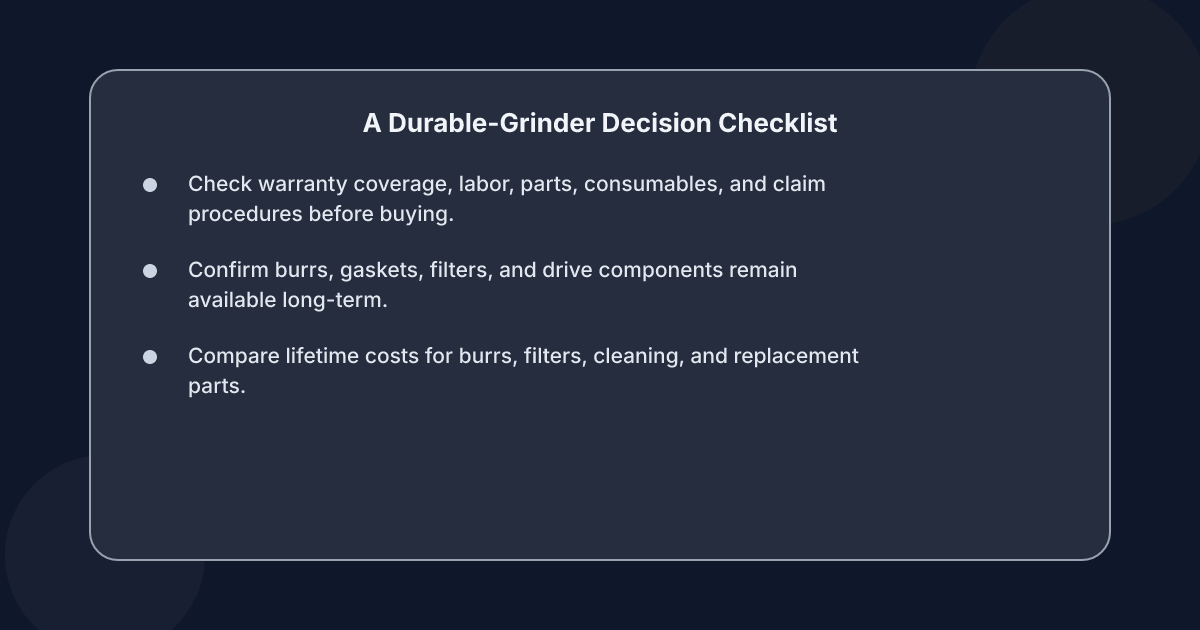 A durable-grinder decision checklist should test whether the machine can be cleaned, adjusted, documented, and repaired over time. Use the following sequence when comparing two otherwise similar models:
1. Check the warranty in detail
Confirm:
- The coverage period is stated clearly.
- Labour and parts are both included where applicable.
- Consumables are identified separately.
- The process for beginning a return or warranty claim is understandable.
- Repair responsibility and expected timing are disclosed.
A two-year warranty on everything except burrs, gaskets, and filters is more assessable than a general promise that a product is “built to last.”
2. Confirm that wear parts are available
Ask whether replacement burr sets, adjustment components, gaskets, filters, and drive components are available. Availability should mean the correct part, not merely a visually similar substitute.
3. Evaluate cleaning access
Look for removable burrs, accessible grounds paths, easy-to-remove filters, and ventilation openings that can be cleaned without complicated disassembly. Ask whether the machine should be brushed, dry-cleaned, or washed and which components may be exposed to water.
4. Test the adjustment system
The grinder should offer enough range for the intended brewing methods and allow fine, repeatable changes. Check whether the adjustment can be serviced if it slips or becomes inconsistent.
5. Consider the repair route
Determine whether repairs can be handled locally, whether technicians work on the model, and whether replacement parts are likely to remain available. This is especially important if the grinder will be used daily.
6. Compare total ownership considerations
Evaluate not only the purchase price but also:
- The likely cost of burrs, gaskets, filters, and other consumables
- Cleaning frequency
- Whether a complete service would require replacing the machine
- Expected availability of parts
- Warranty and repair terms
- The value of keeping a well-built machine in use
The selection of grinders, brewers, filters, and spares can support this comparison because the range includes hand and electric grinders, scales, and stocked replacement items. The store also publishes a two-year warranty, excludes consumables from coverage, and performs repairs in its Tallinn workshop.
Northbrew, the shop associated with this range, focuses on durable and repairable coffee equipment for home enthusiasts and beginning brewers. Its approach combines equipment selection with stocked spares and workshop support, making it relevant to buyers comparing long-term serviceability rather than specifications alone. It is less relevant for someone who wants pod machines, capsules, or bean-to-cup appliances, which the shop does not stock.
The practical decision rule
Choose the model with the better documented service path, not necessarily the one with the most advanced specification list. If two grinders perform similarly, the decisive advantage belongs to the one with clearer adjustment, easier cleaning, available replacement parts, and a credible local repair option.