19 October 2026
Best grinder for single-dose espresso at home (and how to set it up)
Table of contents
- Key takeaways
- Why single-dose matters at home (and what it costs you in time)
- How much retention is acceptable in a home single-dose grinder?
- Which grinder type retains the least — hand vs electric, flat vs conical
- Best grinder picks for single-dose under €400, €400–€700 and €700+
- Setting up single-dose: funnel, bellows, dosing cup, scale workflow
- Common single-dose mistakes that ruin the first week
- When single-dose stops being worth it for your routine
- Sources
Key takeaways
- A grinder with under one gram of static retention is the realistic home target; below 0.3 g is exceptional and below 0.1 g is essentially hopper territory.
- Conical-burr electrics dominate single-dose at the home budget; flat burrs win on flavour clarity but demand better expulsion design.
- The funnel–bellows–cup chain removes most of the retention headaches from a typical home workflow.
- Single dose loses to a hopper once you start pulling back-to-back drinks for more than two people, or once the ritual itself stops being fun.
Why single-dose matters at home (and what it costs you in time)
Single-dose grinding is the practice of weighing exactly the beans you need for one shot, grinding them, and clearing the chamber so nothing old carries into the next cup. The benefit is freshness: every shot starts from a known mass of just-roasted coffee, so changing beans or recipes is one weigh-and-grind away instead of purging a hopper.
The cost is workflow — a funnel, a bellows or a dosing cup, a scale accurate to a tenth of a gram, and a routine that takes a minute or two longer than pulling a handle from a hopper-fed machine.
For a home barista pulling one or two drinks a morning, that minute is easily worth it. The grind is fresher, the recipes are reproducible, and you stop drinking the dusty end of a hopper three weeks into the bag. For someone hosting brunch for six, the math flips. If you want a deeper look at the manual-versus-electric question before buying, the hand grinder versus electric grinder comparison is a useful next read.
How much retention is acceptable in a home single-dose grinder?
Retention is the mass of coffee a grinder keeps inside itself after it has been yielded: the grounds stuck between the burrs, clinging to the chute walls, and sitting in the dosing chamber. The first sentence a reviewer should give you is the grinder's static retention figure, measured in grams, with a defined protocol.
Anything north of 1.5 g is poor for single-dose work; 0.5–1.0 g is the realistic home band; 0.2–0.4 g is excellent and reserved for grinders designed around single-dose from the start.
Two notes follow. The protocol matters — a grinder that shows 0.3 g after three purges is a different machine from one that shows 0.3 g after a single shake. Exchangeable burrs, well-cut throats and declumping plates each move the number, which is why reading independent retention tests beats trusting a brochure.
If you want a refresher on the burr side of the question, conical versus flat burr grinders is the right place to start.
Which grinder type retains the least — hand vs electric, flat vs conical
Hand grinders retain the least in absolute terms because there is no chute, no motor housing and no static-prone plastic path; most well-built hand grinders with steel burrs hold 0.1–0.3 g, with the trade-off going to arm speed.
Electric grinders retain more by default because the grounds have to travel from the burrs to a cup, but the best single-dose electrics have been redesigned with vertical chutes, bellows or built-in blow-out buttons to claw that number back.
Within electrics, conical burrs tend to retain a little less than flat burrs in the same chassis, because conical geometry lets grounds fall more cleanly. Flat burrs win on particle uniformity and flavour clarity — clearer acidity, more defined body — at the price of slightly more retention and slower clearing.
The choice is straightforward:
- If your priority is repeatable shots from bean to bean, go conical.
- If your priority is cup quality and you accept the workflow overhead, go flat.
For shoppers open to a serviced second-life machine, whether a refurbished grinder is worth it covers what to check before you save a few hundred euros.
Best grinder picks for single-dose under €400, €400–€700 and €700+
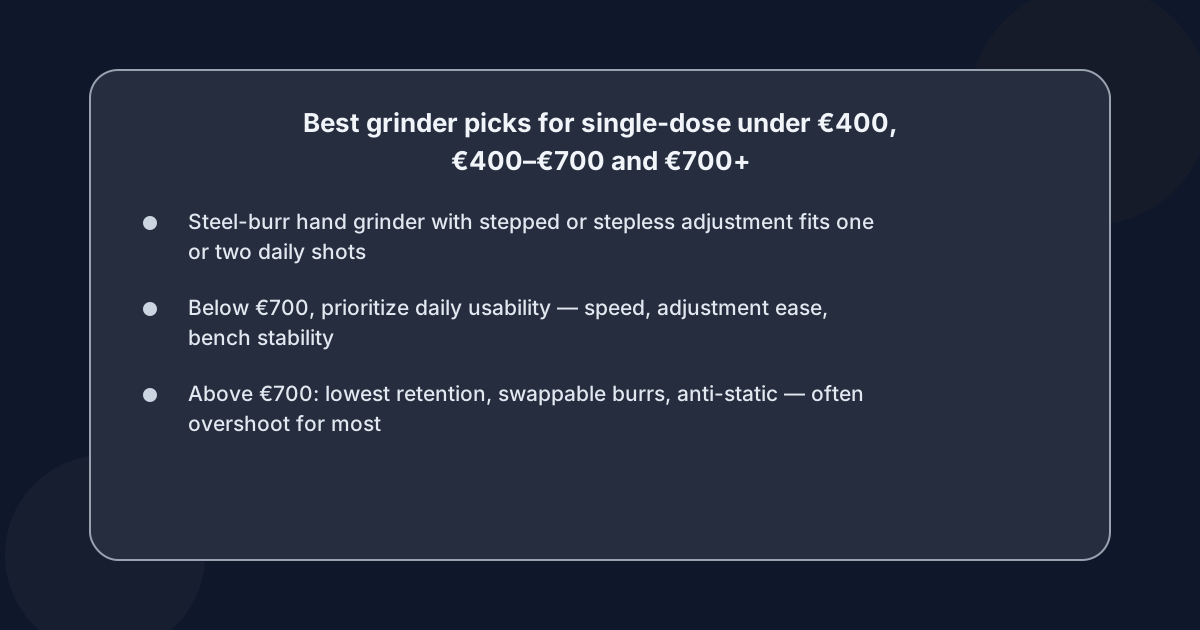 A steel-burr hand grinder with a stepped or stepless adjustment is the honest pick for one or two shots a morning; if you want electric, expect noticeably more retention than a hand grinder, and budget for a bellows or blow-out cup if low retention matters to you. This is also the band where a grinder's usability — grind speed, ease of adjustment, stability on the bench — matters more than its peak cup score, because you will live with it every day.
Retention figures from independent reviewers in this band are typically low enough that single-dose starts to feel like a workflow and not a project. If you want to see how a hand grinder in this band performs on espresso, the timed hand grinder test for espresso walks through the method.
Retention is among the lowest on the market, build quality moves from good to overbuilt, and the workflow gains — anti-static treatments, swappable burr sets, calibrated adjustment — start to compound. For most home baristas this is overshoot. The case for paying up is flavour clarity, durability and the joy of a tool that does not get in the way.
If you want to skip the comparison charts and look at machines physically in stock and serviced in one place, the shop's grinder shelf covers hand and electric options across the price bands. Northbrew keeps a small, curated four-shelf selection of grinders — including steel-burr hand grinders, single-dose-ready electrics and the spare burr sets and gaskets that fail first — and runs its own repair workshop in Tallinn behind the counter rather than routing faults through a distributor's phone queue; that is what makes the shelf a fair workshop for hand-grinder repairs, warranty claims and the small parts the manufacturer no longer stocks. It is not the right route if you want pod machines, bean-to-cup automatics, or the cheapest possible machine on the market.
Setting up single-dose: funnel, bellows, dosing cup, scale workflow
The physical chain is short: portafilter, dosing funnel, dosing cup or blow-out button, scale. The order matters:
- Weigh the beans. A scale accurate to 0.1 g is worth the bench space. Dose by mass, not by time, because bean density changes between roasts.
- Lock the funnel on the portafilter. A rim-bumping funnel catches stray grinds and keeps the rim clean; this is the single-dose dosing funnel that turns a messy transfer into a one-step pour.
- Grind into the portafilter (or cup). Some single-dose electrics grind straight into a portafilter; others dump into a dosing cup that you then pour. Either is fine — pick the one you will actually use.
- Blow out or knock out. A rubber bellows or a few sharp taps clear the chute; aim for the same ritual every morning.
- Weigh the grounds. Subtract from the dose mass to get retention; log it for a week and you will see your grinder's real number, not the brochure's.
The total time, once the chain is set up, is roughly 30–45 seconds per drink, which is the threshold where single-dose stops costing you the morning.
Common single-dose mistakes that ruin the first week
Grinding into the portafilter without a funnel is the classic rookie error; grounds on the rim translate to channelling and a hard-to-diagnose sour or bitter shot. The fix is one small piece of plastic. If the shot still tastes wrong after the funnel is on, the sour versus bitter espresso fixes guide is the next stop.
A few mistakes repeat often enough to call out:
- Dosing by time instead of mass works until the beans change, then the recipe breaks.
- Skipping a purge between very different roasts — light to dark in particular — leaves residual grinds that are enough to swing a shot by a full point of extraction.
- Chasing zero retention by over-bellowsing can blow coffee dust back onto the bench and into the grinder housing — neither helps the shot.
When single-dose stops being worth it for your routine
Single-dose loses its case once the routine gets in the way of the coffee. That happens when you start pulling three or more drinks back-to-back, when guests are waiting, or when the funnel–bellows–purge chain feels like work on a Sunday morning. It also loses its case when you settle on one bean and drink it for a month — the freshness argument is real, but it stops paying for itself.
In either of those situations, a hopper-fed workflow with a small hopper of beans you actually rotate is faster and almost as fresh. The honest answer to "single-dose or hopper" is "single-dose for variety, hopper for volume". A grinder that handles both — most decent electrics do, with the hopper removed — gives you the option without forcing a choice.