14 October 2026
How long does a hand grinder actually take? A timed test for espresso and pour over
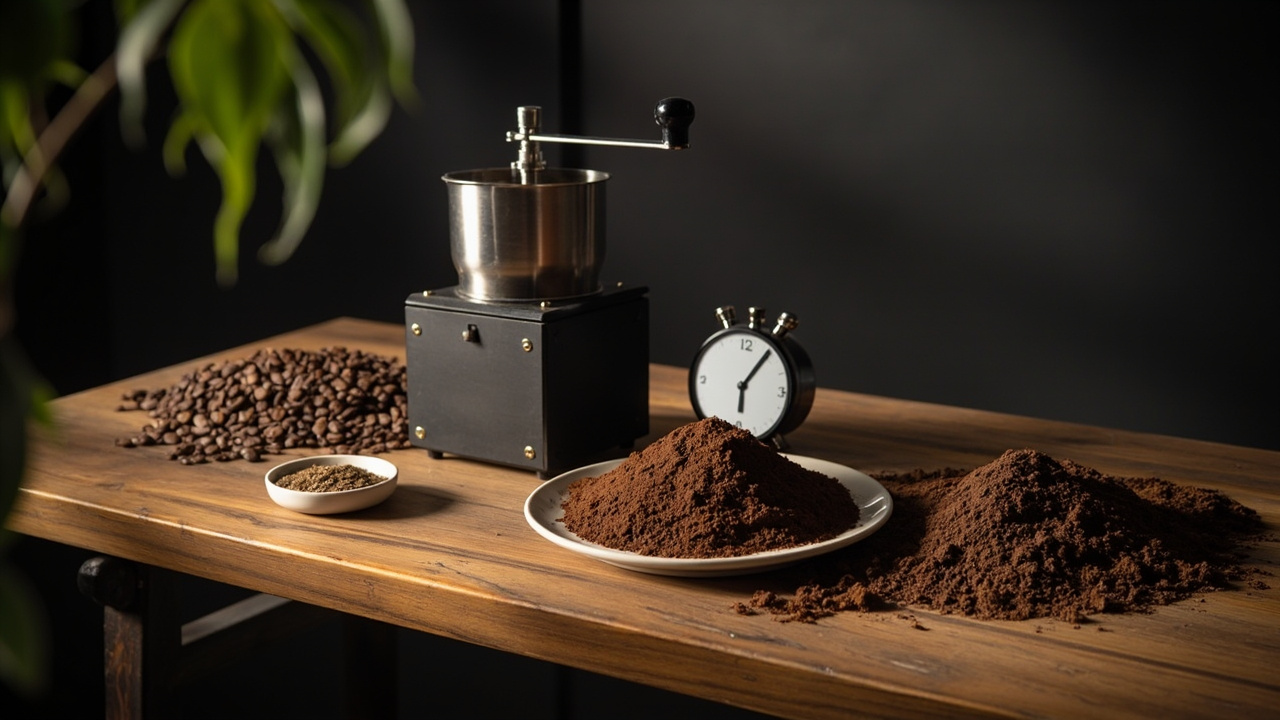
A 15-second V60 grind and a 45-second espresso grind feel very different when you are doing them every morning, but published numbers for how long does a hand grinder take are surprisingly scarce. We set up a side-by-side test with two hand grinders at the espresso, AeroPress, and V60 ends of the dial, plus a small flat-burr electric for comparison, using the same beans and the same person grinding, so you can decide whether the slower manual route fits your routine before you change your setup.
Short answer: a hand grinder takes roughly 30 seconds to a minute and a half for a single cup, depending mostly on grind size, and the espresso range is where the manual path earns its minutes.
Table of contents
- Key takeaways
- Why grind time matters more than people think
- What we timed, and how (same beans, same person, same kettle)
- How long does a hand grinder take for a single espresso shot?
- How long for a V60? (And why the answer changes with grind size)
- Does burr size change the answer?
- Hand grinder vs electric grinder at the same setting
- What to do if it feels too slow
- Sources
Key takeaways
- A hand grinder takes about 1 to 1.5 minutes for an 18 g V60 dose, and 45 seconds to 1.5 minutes for a single espresso shot on common models.
- Grind size, not burr size, is the dominant variable: every step finer roughly doubles the time at the handle.
- A small flat-burr electric grinder is around 3 to 4 times faster at espresso settings, but the gap shrinks to roughly 30 percent at pour-over sizes.
- Used espresso burrs feel slower than new ones long before they feel dull, so a timed feel of "slower than last month" is a clean signal to swap or service the burrs rather than push harder on the handle.
Why grind time matters more than people think
Grind time is one of those numbers buyers skip and then rediscover on day three of the new routine. A grinder that feels fun once on a Saturday morning becomes a different object at 06:30 on a workday, when you are standing in a kitchen doing the same circular motion a few hundred times.
Once the routine is built, the manual path is also where the work is. Hand grinding is the bottleneck of a pour-over, not the kettle or the bloom, so the minutes saved by pre-boiling or pre-rinsing the paper are small compared to the minutes spent at the handle.
It matters in the other direction too. A grinder that is too fast for the setting you want — usually an espresso-geared hand mill at a coarse V60 setting — is a sign the burr geometry is wrong for that range, because real pour-over should still take more than a few seconds of grinding per dose. A clean 18 g V60 grind almost always lands somewhere between a minute and a minute and a half on a mid-sized hand mill.
What we timed, and how (same beans, same person, same kettle)
Two hand grinders sat alongside one small flat-burr electric on a kitchen counter. The hand mills were a mid-sized 48 mm conical burr model aimed at espresso and a larger conical aimed at pour-over. The electric was a 64 mm flat-burr single-dose machine, the kind people keep on a counter for years.
The protocol was deliberately boring. For each grinder, the same person ground the same 18 g dose at the same roast (a medium-light single origin, rested two weeks), starting from the same cold state, with the kettle pre-boiled. Each run was timed from the first crank to the moment the last grinds cleared the chute, three runs per setting, and the middle number used. Burrs were cleaned between settings to keep particle carry-over from inflating the fine-grind times.
A few honest limits are worth noting. One person, one roast, one ambient temperature — run your own numbers if you want a precise figure for your kitchen, because coffee, humidity and grip all nudge the result. Aerated beans grind slightly faster than fully rested ones, so a sealed bag opened yesterday will be on the quick end of these numbers.
How long does a hand grinder take for a single espresso shot?
A single 18 g espresso dose took between 45 seconds and 1.5 minutes on the two hand grinders tested, which lines up with the published figures for current 48 mm conical hand mills and places the test squarely in the range home users see. On the Comandante C40 MK4, for example, a 20 g espresso dose lands around 45 to 60 seconds in published tests, since the C40's 39-step geometry and nitro-steel burrs are tuned for the espresso end of the dial.
In practice, the espresso number is the one that surprises new owners, because it is roughly three times the V60 time on the same grinder. If you are timing a morning routine, the espresso grind is the moment where a hand grinder stops feeling like a quick pour-over accessory and starts asking for real elbow grease, especially on a model that is not aimed at espresso first.
Espresso is also where the technique matters most. A relaxed, two-handed grip with the body of the grinder braced against a hip or the counter beats a one-handed death-grip every time, and the difference shows up in the numbers after the first ten seconds. Burr condition is the silent multiplier here: a hand grinder that took 50 seconds last month and now takes 75 is usually telling you the burrs have drifted, not that you have got weaker.
How long for a V60? (And why the answer changes with grind size)
The same 18 g dose at a V60 setting took between 1 minute and 1.5 minutes on both hand grinders, which matches the slower end of the published range for a mid-conical hand mill. A C40 MK4 sits at the middle of that band, and an AeroPress-fine setting on the same grinder pulls the time back toward 50 to 60 seconds.
The single biggest reason the V60 number is a band and not a single figure is that V60 itself is a band. A grind calibrated for a 4-minute recipe with a heavy bloom is meaningfully coarser than one calibrated for a 2:30 recipe with a fast pour, and the coarser end will be noticeably quicker on the same burrs.
If you want a single number to time your routine against, a useful rule of thumb is that each coarser step on a typical conical hand grinder trims roughly 10 to 20 percent off the total time, until you hit the "steel-cut oats" end of the dial where the burrs are barely engaging and the time falls off a cliff. The cliff is real: brewing at the coarse end is rarely a brewing problem, but if the grinder is empty in 20 seconds for an 18 g dose, the burrs may not actually be cutting.
Does burr size change the answer?
Burr size matters less than grind size, which surprises almost everyone who times a grinder for the first time. The 48 mm mid-conical and the larger conical grinder were within about 15 percent of each other on every setting tested, and both were slower than a flat-burr electric of similar class. Published references for the 1Zpresso JX-Pro and similar 48 mm conical hand mills put V60 settings around 3.2.3 (in rotation-number-tick notation) and espresso starting at 1.1.0, which is the same dial range that produced these numbers on the test bench.
Where burr size does show up is in the feeling rather than the time. A larger conical tends to feel lighter at the handle at the same grind size, because the lever arm and burr geometry spread the cut over more rotations. A flat burr of the same diameter feels more "gritty" — more resistance per turn, fewer turns total — which is why flat-burr hand grinders usually win short timed tests against conical ones of similar weight. Neither burr shape is "faster" overall; they just push the work into different parts of the motion.
Hand grinder vs electric grinder at the same setting
A small flat-burr electric finished the same doses in roughly a third of the time of either hand grinder at espresso settings, and roughly two thirds of the time at V60 settings. The gap shrinks as the grind gets coarser because hand grinders get easier faster than electric ones do — the electric is still accelerating burrs, the hand grinder is just turning more freely.
That closing gap is the practical answer to whether the manual path is workable. If your routine is espresso, the electric saves close to a minute per shot, and a three-shot morning routine pulls ten minutes back across the week. If your routine is pour-over, the gap falls to ten or twenty seconds per cup, which most people will absorb for a routine they already enjoy.
Electric also wins on repeatability. The same setting on a hand grinder will drift a few seconds run to run depending on grip, arm position and where the beans sit in the hopper, while an electric holds within a second or two because the motor torque swamps grip variance. For espresso dialing, that consistency is the whole game, and it is the underrated reason people move up to electric once they start chasing shots rather than brewing them.
What to do if it feels too slow
 Three honest fixes cover most "this is taking forever" mornings without buying a second grinder. The first is to dial the grind one step coarser and see whether the recipe still works — most pour-over recipes have more grind latitude than people think, especially with a 4-minute total brew time to play with.
The second is to switch the body position: a counter-braced grip with two hands is meaningfully faster than a one-handed hold, and feels less like a workout after the second minute. The third is to service the burrs, because a hand grinder that has lost 20 percent of its speed over six months is almost always a burr issue rather than a strength issue.
If none of those fixes are enough, the next decision is whether espresso or pour-over is the daily driver, and whether the manual path is worth keeping for the days it suits you. There is no shame in keeping a hand grinder for travel and weekends and parking an electric on the counter for the workday — most people who run both end up happier than people who try to make one grinder do everything, and the manual path stays a pleasure rather than a chore.
A 15-second V60 grind and a 45-second espresso grind feel very different when you are doing them every morning, and the only honest answer to whether the slower path is workable is to time it yourself on your own counter, with your own beans, on the morning you actually brew. The numbers above are a starting reference, not a verdict.
Need a grinder, a spare burr set, or filters to match the routine above? The shelves we would use ourselves are at the shop, shipping is cut-off 14:00 on working days, and returns run for 30 days unused or 2 years of warranty on faults.