1 October 2026
Is a Water Filter Worth It for Coffee in a Hard-Water City?
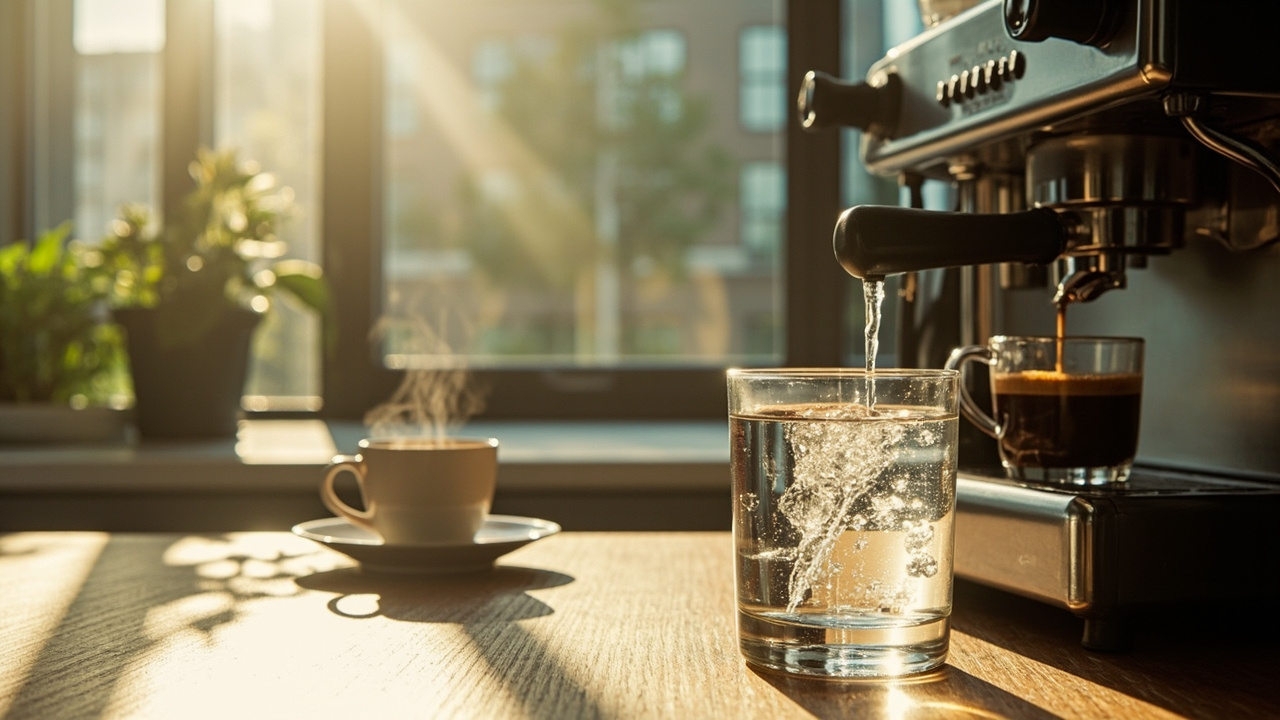
Hard water changes how coffee tastes and slowly eats the inside of the machine; a filter is the one habit that protects both, and the real question is what skipping it ends up costing — in taste, in repairs, and in the machine itself. In most European cities the water coming out of the tap sits somewhere between 15°fH and 35°fH, which is already in the range that scale builds inside boilers, on showerheads, and on the heating element of an espresso machine. A dedicated water filter for coffee in hard water is the cheapest way to keep that mineral load from reaching the parts that actually touch the brew.
Table of contents
- Key takeaways
- How do I know if my tap water is hard enough to be a problem for coffee?
- What does hard water actually do to a coffee machine over time?
- Hard water vs the cup: what changes in taste, and what doesn't
- What does a home water filter for coffee actually cost to run?
- What happens if I skip the filter and just descale instead?
- So is a water filter worth it for coffee in a hard-water city?
- Sources
Key takeaways
- Above roughly 8–10°fH, the calcium and carbonate in tap water start to plate out as limescale inside boilers, on heating elements, and inside group heads.
- Taste changes come first: a flat, dusty, or "chalky" cup is usually mineral interference, not stale beans.
- Filters cost pennies per litre to run; descaling cycles cost a descaler, time, and a small but real risk of damage if you forget.
- A simple hardness test strip tells you in thirty seconds whether you have a problem worth solving.
- For most home baristas in hard-water cities, the answer is filter first, descale as a backup, never filter alone with no descaler in the drawer.
How do I know if my tap water is hard enough to be a problem for coffee?
You do not need a laboratory — a strip or a soap-bottle test tells you in a minute, and the number you write down decides whether a water filter is optional or essential. Most European cities publish a hardness figure for the local supply; anywhere above about 8–10°fH (French degrees) or 4 °dH (German degrees) is enough to cause limescale in a kettle within weeks and to shorten the life of an espresso boiler.
A 30-second strip test, dipped into a cold cup of tap water and read against the colour chart on the pack, is the simplest way to get a real number. The cheap ones from a hardware shop or aquarium section are good enough for the decision you are about to make. The official figure from your water utility is better, but only if it is current; some suppliers soften in winter and not in summer, and the printed number on the bill can be a year out of date.
How do I read a hardness test strip without overthinking it?
Match the strip to the closest colour, round down, and write the number in °fH on a piece of tape stuck to the boiler. Below 4 °fH the water is genuinely soft; 4–8 °fH is the "fine for kettle, fine for pour-over" middle band; 8 °fH and up is where a home barista water filter starts paying for itself.
If you cannot get a strip, the proxy test is a kettle: if the inside of a cheap kettle turns cloudy white within three months, the same water is doing the same thing to the inside of a machine that costs ten times as much. That is the whole decision in a single observation.
What does hard water actually do to a coffee machine over time?
Hard water deposits calcium carbonate on every surface it touches that is hotter than about 60 °C — which is, by coincidence, exactly where a coffee machine works. Scale builds on heating elements first, then inside boilers, then in the narrow channels of a group head or steam wand. The boiler has to work harder to reach the same temperature, the flow becomes uneven, and eventually a valve sticks or a thermoblock cracks.
The damage is invisible until it is not. A thin white film on the heating element is only a millimetre thick, but it is also a thermal insulator, so the element runs hotter and longer for the same shot. That extra heat ages the element faster and starts to bake any remaining minerals into a harder layer. Over two or three years, the inside of a neglected boiler can look like the inside of a kettle that nobody has ever descaled — grey, crusty, and reduced to a fraction of its original flow.
How long does an espresso machine actually last on hard water without a filter?
A typical home espresso machine used daily on 25 °fH water, with quarterly descaling, will show measurable flow loss and shot-temperature drift within two to three years, and the boiler or thermoblock usually fails within five. The same machine on filtered water, with the same descaling habit, often runs for ten years and is still in spec when it is finally replaced for something newer. None of this is dramatic; it is a slow tax, paid in slightly worse coffee and eventually in a repair.
A kettle tells the same story faster: a kettle on hard water shows a visible white crust on the element within months, and the first sign in a pour-over setup is a slow drain because the holes in the paper are clogged with mineral film. That same film is what you are not seeing inside the boiler.
Hard water vs the cup: what changes in taste, and what doesn't
Hard water changes the cup far more than most people realise, and the changes are easy to read once you have a clean baseline. Filtered water is the control; the difference between a coffee brewed with the same beans in soft water and in 25 °fH tap water is usually large enough to identify in a blind triangle test. The classic descriptors are dusty, chalky, flat, and a metallic or dry finish that lingers on the back of the tongue.
The chemistry is simple. Calcium and bicarbonate buffer the brew pH upward, which mutes acidity and flattens the bright top notes that make a good coffee taste like anything other than "coffee". Magnesium has the opposite effect at low doses and is partly why some bottled waters taste so good to brew with, but past a certain point the mineral load is just noise on top of the bean.
Does a filter change the taste of pour-over coffee as much as it changes espresso?
Yes, often more, because pour-over has no thermal mass and no boiler to mask the water. A V60 or Chemex on 30 °fH tap water tastes noticeably duller than the same recipe on filtered water, and the difference is the first thing most people notice when they switch. The decision rule: if you can taste a difference in the kettle, you can taste it in the cup, and the answer to "do I need a water filter for pour over" is usually yes once the local hardness is over 10 °fH.
The cup-side effect is honest and easy to verify. The machine-side effect — what hard water does to the boiler — only shows up later, and that asymmetry is why most people who skip filtering regret it for the machine long before they regret it for the taste.
What does a home water filter for coffee actually cost to run?
For a home barista running one or two coffees a day, the running cost of a basic inline filter is between roughly 5 and 15 cents per litre of brew water, dominated by the price of replacement cartridges. After that, the only recurring cost is the cartridge, swapped on a schedule that depends on the local hardness.
A typical set-up looks like a compact carbon-plus-ion-exchange cartridge plumbed either into the cold supply under the sink or into a small countertop tank. The carbon strips chlorine and the organics that ruin taste; the ion-exchange resin swaps calcium and magnesium for sodium and hydrogen, which is why filtered water tastes faintly different from tap and does not scale.
How long does a filter cartridge actually last before it stops working?
Most cartridges are rated in litres and run from roughly 1,500 to 4,000 litres before the ion-exchange resin is exhausted. The single most common mistake is leaving a cartridge in place past its service life: it keeps flowing water, but the ion exchange has stopped, and you are back to straight hard water without knowing it.
That failure mode is the reason most manufacturers stamp a change interval on the cartridge and print a TDS reading on the box. The smart move is to write the install date on the housing with a marker and to keep a spare cartridge in the cupboard so a swap takes thirty seconds, not an afternoon.
What happens if I skip the filter and just descale instead?
Descaling cleans the scale that has already formed; it does not stop the next layer from forming tomorrow. Treating descaling as the strategy instead of the filter means the boiler is permanently building up and periodically being cleaned out, which is more wear, more maintenance, and a constant small risk of leaving descaler residue in the machine if a rinse step is missed.
In a hard-water city, the practical cadence is roughly once a month for an espresso machine, every few weeks for a kettle, and never for a pour-over kettle because there is no sealed boiler to flush. A bottle of citric-acid or commercial descaler costs a few euros and does the job, but the cycle is endless: descale, brew, descale, brew. The machine is, on average, half-scaled at any given moment, and the only thing that changes is which half.
Is descaling coffee machine vs filter a real choice, or do you need both?
Both, in the right roles. The filter does the steady, day-to-day work of keeping new scale out; the descale cycle cleans the residue that slips through during a long brew, a missed cartridge change, or a stretch of particularly hard incoming water. The descaling coffee machine vs filter question is therefore a false binary; the answer in a hard-water city is filter on the supply and descaler in the cupboard, used on a real schedule rather than when the machine starts sulking.
The "just descale" route also has a quiet second cost that is easy to miss. Acid descalers slowly etch aluminium boilers and gaskets, and citric acid in particular is hard on rubber seals if the rinse is not generous. Over years, the descale-only path is harder on the machine than the filter-and-occasional-descale path, and the repair bills line up accordingly.
So is a water filter worth it for coffee in a hard-water city?
 Yes, with a qualifier: it is worth it if the local water is above roughly 8–10 °fH, and not worth the bother if it is below 4 °fH. In the band between 4 and 8 °fH, a filter is still the cheapest insurance against limescale in a kettle, and the taste difference is small but real.
For a typical specialty-coffee drinker in a European city on mains water, the case comes down to three numbers. A cartridge costs a few euros a month. A repair on a scaled espresso boiler costs a few hundred. The difference between filtered and unfiltered water in a side-by-side cup is large enough to be obvious after two brews. The math, and the taste, both go the same way.
If the only thing holding you back is the question of "best water filter for espresso machine", the honest answer is that the best one is the one you actually change on schedule, plumbed into the cold supply, with a TDS reading you can check. Brand matters less than cartridge life and spare-part availability. And if the question is whether does hard water affect espresso machine enough to matter, the answer is yes, it does, every day it runs unfiltered.
For the people who already own a grinder and a brewer and just want the next thing in the chain to be right, the move from hard tap to filtered water tends to be the single highest-leverage change they can still make. Stocking the cartridges and keeping a small descaler on the shelf, rather than chasing the perfect burr set, is the boring upgrade that pays back the longest. A small specialist shop that stocks the right cartridges and the matching kettles, scales and filters in one place — the kind of place with a Grinders, brewers, filters and spares page that lists them on the same shelf — is usually the shortest path to a working setup, and a quick look at the Delivery times and what shipping costs page before checkout keeps the only surprise a pleasant one.
When the kettle starts leaving white dust and the espresso runs a degree or two cooler than it used to, that is the moment to stop debating and start filtering. For readers who already know their local hardness and want to talk through which cartridge fits their machine, Contact the shop the workshop directly — a person usually answers the same day, and the answer is almost always the same: filter on the supply, descale on a schedule, and a spare cartridge in the cupboard.