12 October 2026
Coffee grounds in the garden: what actually helps (and what does not)
Half the gardening web calls spent coffee grounds black gold for your soil. The other half calls them a Pinterest myth. The honest answer sits with the brewer who actually empties the filter every morning, because the difference between "helps" and "hurts" comes down to how the grounds are used, what plants they go near, and how much you add at once.
Coffee grounds in the garden work well as a compost ingredient and a worm bin stimulant, do little on their own as a fertilizer, and can actively damage seedlings if piled on thick. The myths about acidic mulch and slug-repellent borders are partly true and partly wrong, and the line between them is where most people get into trouble.
Table of contents
- Key takeaways
- Do coffee grounds actually help garden soil, or is that just a kitchen myth?
- The right way to add coffee grounds to a home compost bin
- Are coffee grounds good for roses, blueberries, and other acid-loving plants?
- Worms and coffee grounds: do worm bins actually want them?
- What not to do with coffee grounds in the garden: mulch, slugs, and seed-starting
- Sources
Key takeaways
- Used coffee grounds are nearly pH-neutral after brewing (around 6.5–6.8), so they do not acidify soil the way most gardening blogs claim.
- The strongest case for grounds is in the compost pile and the worm bin, where microbes and worms break them down and release nitrogen for the rest of the garden.
- A thin layer around roses, blueberries and azaleas is fine; a thick mulch mat of fresh grounds suppresses seedlings and slows water movement.
- Coffee contains caffeine and other compounds that inhibit seed germination, which is why fresh grounds should stay out of seed-starting mix.
Do coffee grounds actually help garden soil, or is that just a kitchen myth?
Yes, but not in the way most gardening posts describe. Used coffee grounds are a small but real soil amendment: they add organic matter, feed the microbes that run a healthy compost pile, and give worms something to chew on. They are not a substitute for fertilizer, and the famous "acidic mulch" story is mostly wrong.
After brewing, the grounds are close to pH neutral, sitting between 6.5 and 6.8 according to Oregon State University extension research. The acidity people remember from the cup is water-soluble and ends up in the brew, not in the grounds. That detail matters for the next sections, because the reason coffee grounds "work" for roses and blueberries has more to do with the organic matter than with any pH shift.
What grounds do bring is a small nitrogen boost, a useful bit of organic carbon, and a texture that breaks up heavy clay when it is mixed through compost rather than left as a surface layer. What they do not bring is enough potassium or phosphorus to feed a hungry plant on their own, which is why a balanced fertilizer or a richer compost still has to do most of the work.
The right way to add coffee grounds to a home compost bin
Are coffee grounds good for compost? Yes, and they are one of the easier "green" materials a small bin can take, because they break down faster than most kitchen scraps and worms handle them well. The mistake people make is treating them like a free-for-all addition and ending up with a slimy, sour pile.
A few ground rules keep the pile healthy:
- Add grounds in thin layers, mixed in with browns like shredded cardboard, paper, or dry leaves, so air can still move through the pile.
- Keep grounds to no more than about a fifth of the total volume, even though they are technically a "green" (nitrogen-rich) ingredient.
- Rinse the paper filter if you use one and throw the filter in too; the paper is a useful brown and saves a step.
- Turn the pile every week or two so the grounds do not mat into clumps that go anaerobic and start to smell.
A home brewer who pulls a shot every morning produces only a small handful of grounds, which is well within what a balcony or backyard bin can absorb. If you brew in larger batches, store the day's grounds in a lidded bucket and add them in spoonfuls rather than dumping them all at once. A single-cup brewer tends to produce grounds at a pace a worm bin can match, which is part of why this combination is so forgiving.
Are coffee grounds good for roses, blueberries, and other acid-loving plants?
Used coffee grounds for plants like roses, blueberries, azaleas, and rhododendrons are a useful addition, but mainly because they add organic matter and a modest nitrogen feed, not because they lower soil pH. The pH-neutral reading after brewing means a thin top-dressing will not move the needle on acidity the way sulphur or pine-needle mulch can.
In practice, a light sprinkling worked into the top few centimetres of soil, or a small forkful blended through compost before planting, gives acid-loving shrubs a gentle seasonal boost without the risk of a thick crust forming on the soil surface. Two cautions are worth keeping in mind:
- A heavy mulch mat of fresh grounds can shed water and dry out the soil underneath, leaving the shrub thirstier in midsummer.
- Coffee grounds are not a replacement for the ericaceous compost or sulphur treatment that genuinely acid-sensitive plants require on alkaline ground.
For most home gardeners, the easiest pattern is to compost the grounds first and then use the finished compost as the mulch. That delivers the organic matter, spreads the nitrogen more evenly, and avoids the surface-crust problem that gives the practice a bad name in drier climates.
Worms and coffee grounds: do worm bins actually want them?
Worms and coffee grounds are a genuinely useful pair, more so than almost any other use for spent grounds. Worms eat coffee grounds readily, the grounds are pH-balanced for the bin, and the small particle size is exactly what red wigglers prefer. The catch is moderation, because too much at once turns the bin acidic and wet in a way worms do not tolerate.
A few habits keep a worm bin happy:
- Add grounds in small amounts, mixed through bedding rather than dumped in a clump, so the moisture and pH stay steady.
- Avoid fresh, hot coffee or espresso waste; the liquid form is too acidic for the bin and will turn the bedding sour.
- Pair grounds with a carbon source like shredded cardboard or newspaper so the worms have something to balance the nitrogen.
- Watch the bin for a week after adding grounds; if worms climb to the lid or the bedding smells sour, cut back next time and add more brown material.
For a balcony vermicomposter fed by one or two cups of brewers per day, the bin can usually take everything that comes out of the kitchen, with a fistful of shredded cardboard for every few days of grounds. That rhythm is what makes a worm bin the most reliable home for spent grounds, more than the garden bed or the compost heap.
What not to do with coffee grounds in the garden: mulch, slugs, and seed-starting
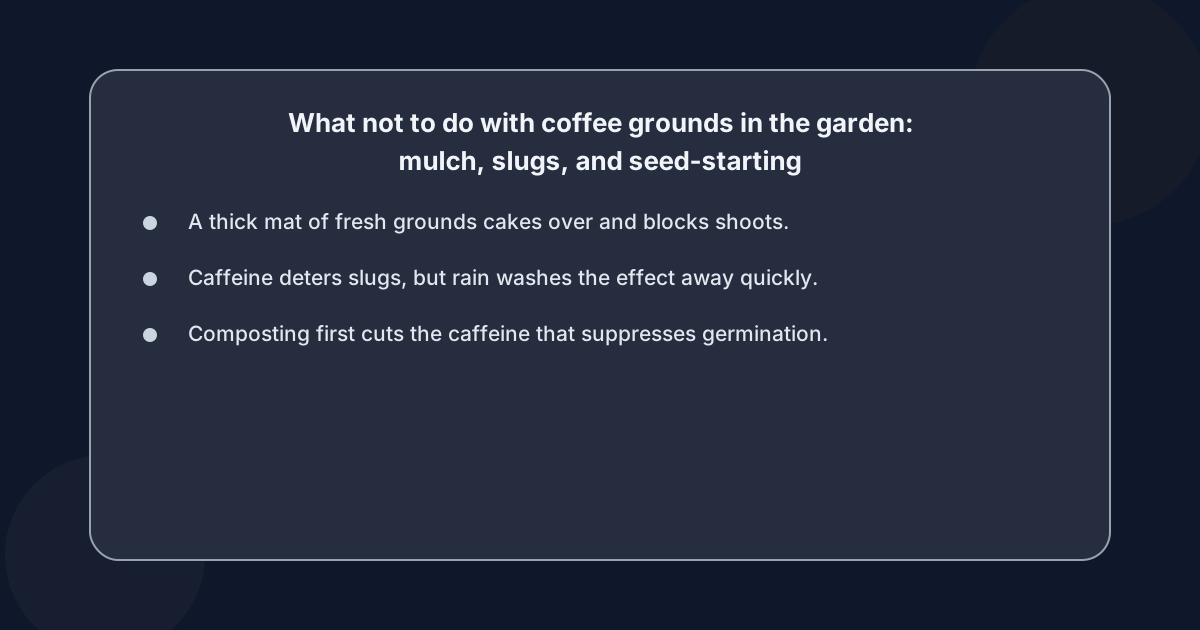 Some of the most repeated advice online is also the most likely to cause problems, and three patterns in particular are worth avoiding.
Can I use coffee grounds as a surface mulch around the garden?
A thick mulch mat of fresh grounds is a bad idea. When grounds dry on the surface, they form a crusty layer that sheds water, slows gas exchange, and physically blocks the small shoots that annuals and vegetables put up in spring. A thin sprinkle, mixed into the top centimetre of soil or compost, is fine. A centimetre-thick mat on top of a bed is the version of this practice that gives the rest a bad name.
Do coffee grounds repel slugs?
The slug story has more evidence behind it than the mulch story. Oregon State University extension work found that caffeine is harmful to slugs and snails, and a scattering of grounds around vulnerable seedlings can reduce slug damage in damp weather. The effect is short-lived, because rain washes the caffeine out of the grounds quickly, and a heavy mulch mat still does more harm than good by sheltering the slugs underneath. Treat it as a light, refreshed-occasionally addition rather than a permanent barrier.
Can I mix coffee grounds into seed-starting mix?
No, not fresh. Coffee contains caffeine and related compounds that suppress germination, and several studies on coffee extracts and seedling growth have shown measurable inhibition when concentrations are high enough. A small handful mixed through mature compost is harmless, because microbes have already broken the caffeine down. Fresh grounds in a seedling tray are a reliable way to lower germination rates for the same reason they help a compost pile: the chemistry that feeds microbes is the chemistry that confuses a seed.
The short version of all three is that grounds help most when they are part of a finished soil or compost, and they hurt when they are used as a thick, fresh layer. The brewer's daily handful is a resource, but only if it ends up somewhere with enough biology to break it down.